Welcome to Creating Kevin Gallery & Studio.
A creative kid, then a lawyer
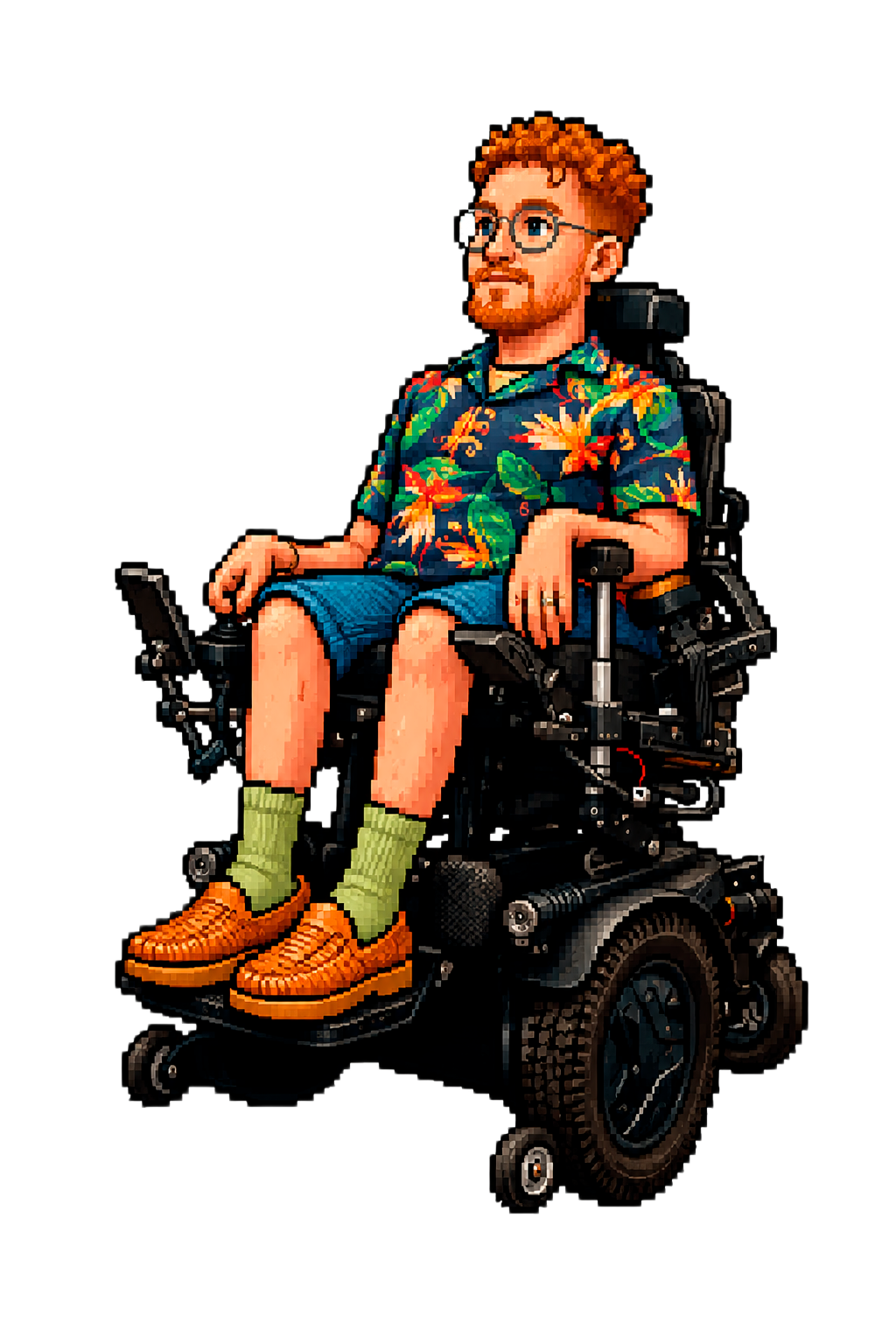
I'm Kevin. I am an attorney, a builder, a problem-solver, and-after a long time learning how to say it plainly-an artist.
My work comes from the place where the digital and the physical meet because that is where I have always had to live. As someone who is significantly physically disabled, I naturally gravitate toward technology, digital tools, and systems-not as accessories, but as forms of access. That relationship has shaped almost everything about how I move through the world. There is often a distance between what I can imagine, what I can feel, and what I can physically do in a direct way. I have always had to find other routes: through devices, through language, through strategy, through the computer, through whatever tool could carry an idea a little farther than my body could on its own. That is part of why art matters to me. There are things I want to release physically-energy, frustration, happiness, pressure, humor, precision, beauty, memory, and all the strange emotions that do not fit neatly anywhere else-but I cannot release them in the usual way. Artistic expression has become one of the clearest places where that energy can go.
Returning to visual art through the computer
I was a creative kid before I ever had language for it. I sang. I wrote music. I drew. I made things. I was the person making the poster, building the PowerPoint, editing the photo, or figuring out how to make the computer do something more interesting than it was supposed to do. Then I became a lawyer, and for a long time I treated art like something adjacent to my life rather than central to it. Law still feels creative to me-it is language, structure, persuasion, strategy-but it was not the whole outlet.
A few years ago, that lifelong pull toward tools and alternate routes started bringing me back to visual art through the computer. At first, the screen was simply the place where I could begin again. I could test ideas in the digital world with an ease I did not have in the physical one. I could draw enormous shapes, build hundreds of layers, stack colors and patterns, move objects around, break them apart, and put them back together again. It felt like a stage. I was the prop master, the director, and the stagehand. I could place these shapes and objects into little worlds and feel my way through them with a clarity that was exciting and new.
I loved falling into the haze and trance of organizing and reorganizing shapes on my screen. When I returned to visual art this time, I was also learning software from the ground up in a completely different era. There were programs, tools, and possibilities I had never touched because I had spent so many years pursuing a more traditional career. It felt like unlocking rooms in a house I already lived in but had never fully explored.
Finding abstraction
At some point, I started wondering whether I should push myself toward more traditional subjects, including the human form. I remember making a nose I was proud of, which felt absurdly epic because every line, curve, shadow, and tiny adjustment had to be dragged into place with one finger-no pencil, no digital pen, no brush in my hand, just a painstaking negotiation between the image in my head and the tool in front of me. I do not say that because drawing with one finger is the only impressive way to make art. Plenty of artists use their bodies, mouths, feet, devices, assistants, and invented methods with extraordinary skill. I say it because, for me, that little nose represented effort. It represented proof that I could force the tool to meet me somewhere.
But it also clarified something: I did not want to spend my life making noses. I was proud of it, and I was also bored by the idea of doing it over and over again. So I returned to what kept pulling me back: shapes.
From digital to physical
Why shapes? Why symbols? Why arrangements that feel like they are about to become something? For a while, that was the question I kept circling. All pun intended. A square, a circle, and a triangle on an artboard can feel dead if they are just sitting there. Of course the relationships matter-the size, the color, the tension, the distance, the rhythm-but at first it still felt too simple for the complicated way my mind was working. I wanted the forms to carry more than design. I wanted them to hold pressure, humor, memory, personality, and feeling.
So I did what any good lawyer does: I researched obsessively. I found Kandinsky, Miró, Paul Klee, Bauhaus forms, and other artists who made abstraction feel alive instead of empty. My mind opened. I started to see that a circle did not have to be just a circle. A line did not have to be just a line. These artists were not trying to prove they could render a perfect face, fruit bowl, or realistic hand. They were building languages. They were turning relationships between shapes into movement, music, emotion, architecture, play, and thought.
That helped me understand why I had been drawn to abstraction all along. Diagrams, cartoons, games, portals, machines, bodies, rooms, and memory all live somewhere in the background of how I see. I notice faces in soap dispensers, personalities in objects, and strange little architectures in ordinary things. I like art that lets the viewer complete the image without being told exactly what it is. That is what those artists showed me: the potential to take something as simple as a circle and make it feel charged, strange, funny, unstable, beautiful, or alive.
For a while, digital work was enough. Then it wasn't. I had fallen back in love with the images I was making-the little shows of triangles, squares, invented shapes, and impossible spaces I was staging on the screen-but I kept wanting them to become more physical. I wanted surface, resistance, texture, interruption, and evidence of touch. That desire was exciting, but it was also frustrating in a way I recognized. It reminded me of so many other moments in my life where I could imagine exactly what I wanted to do, but could not do it in the ordinary physical way.
Even if I had the eye, the taste, or the talent, I did not have the physical ability to make that red circle have real ground, texture, and height by holding a brush in my hand and working the surface like the painters I admired. So I went back to the tools that had always opened doors for me. I found beautiful ways to imitate texture digitally. Some of my favorite private works-pieces I have shared with friends and family-are just digital textures exploring each other, pressing against each other, and creating relationships. They mattered to me. They still matter. But I wanted more.
I experimented with ways to add gel and dimensional layers over printed work. That felt powerful at first: hand embellishment as a kind of height map over the painstaking textures I had already made. But when someone else's hands entered the process, the work immediately stopped feeling like mine. No matter how precise the instruction, someone else's mark is still someone else's mark.
The practice today
I really tried to make it work. I spent months preparing for the moment when I would instruct someone else how to put gel on top of my creations. I made diagrams. I outlined images in bright red to show where I wanted more intensity. I even livestreamed myself using a mouse on a computer to direct exactly where a paintbrush should drop on the composition. But it was never right. It was never the same. It was not my hand, my control, or my own physical relationship to the work.
After a bad day in the studio, I got mad enough to stop being precious.
I had my assistant take some leftover blue paint that had been used on the wall and dish it out on the floor. I ran over it with my wheels. It felt dirty. It felt like something I was not supposed to be doing. My wheelchair was getting covered in paint. But it also felt free because I was making the mess myself.
I haphazardly drew over a piece of digital art I had printed, and I saw it in a brand-new way. Something happened that I could not have planned into existence. The mark was physical, direct, and mine. That moment opened the door to the work I am making now.
Today, my practice combines digital composition, printed surfaces, painted interventions, marks made with the assistance of my wheelchair, stamped forms, texture, and experimental objects. I am interested in art that moves between screen and surface, body and machine, control and accident. The process is not about overcoming disability. It is about using the actual conditions of my body, my tools, my imagination, and my life to make something that could not come from anyone else.
Please explore the Works and Progress pages to see current and developing pieces, visit Process to learn more about how my work is made, check Shows for upcoming exhibitions and events, and use Inquiries if you would like to connect, collect, collaborate, or learn more.
Thanks for being here.
- Kevin